Patent Announcement「Resonance Painting」
In March 2026, I obtained a patent for a painting technique.
This page presents an overview and statement of the patented method, Resonance Painting.
Overview & Concept
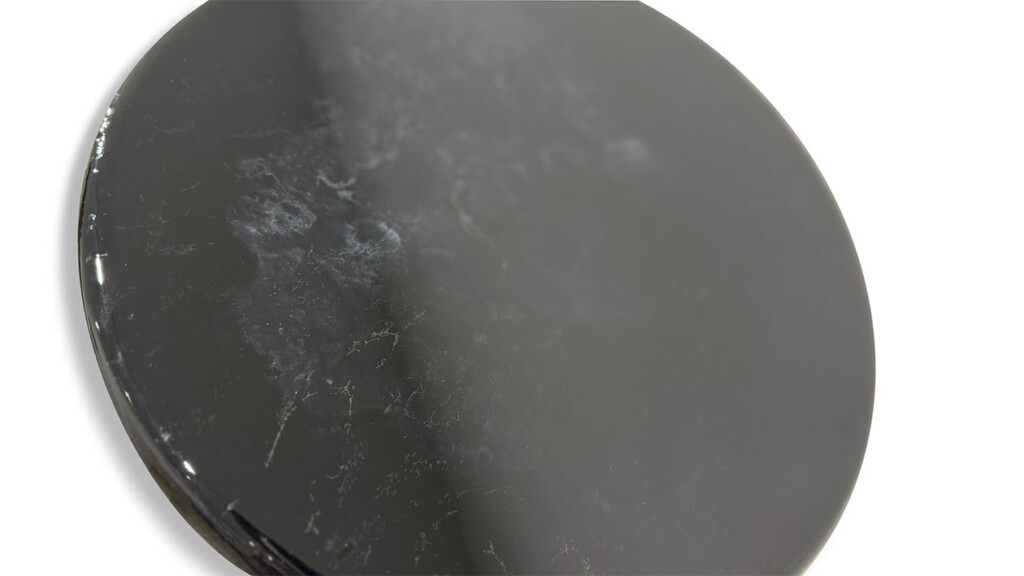
The painting technique I devised (Japanese Patent No. 7839750) achieves high reflectivity and transparency by controlling and reconciling the mutual repulsion properties between materials with differing characteristics, thereby making their integration possible.
Throughout my artistic production process, I encountered challenges (particularly, issues related to the glossy effects) that could not be resolved through conventional painting materials or methodologies used in fine art. By incorporating interdisciplinary materials and techniques, I arrived at a method in which the control of oil content serves as a key process, making it possible to achieve both high reflectivity and transparency.
With the publication of this patent, I am proposing, as one possible perspective, that artists facing challenges in their practice may find potential solutions outside their field.
Furthermore, this attempt seeks to give form to knowledge that might otherwise remain restricted to individual trial and error. By preserving tacit knowledge—practical techniques and discoveries accumulated through production—in the framework of a patent, I intend to establish new connections between artistic practice and technique.
While patents are largely understood as contracts that grant exclusive rights to an inventor, they are fundamentally designed to disclose information to society in exchange for protection for a limited period of time. My intention is to preserve and share the challenges encountered in the process of creation and the methods developed to address those challenges as accessible knowledge.
Moreover, this project is also an exploratory attempt to examine how the principles of the patent system might operate within the field of art and whether it can function as an appropriate framework.
The documented process itself would be an opportunity to reconsider the relationship between artistic expression and the artist.
Statement
[読む]
My works are based on the concept of “inner space,” understood as the psychological and sensory domain that exists within the body. By inner space, I am referring to the internal world we carry within us—formless thoughts and emotions, impulses before they become language, and the rhythms and breath that course through the body, often without our conscious awareness.
I approach the body as a space and construct images by tracing activities that occur within the body across the layers of the unconscious, preconscious, and conscious mind. These activities include subtle pre-emotional stirrings, fleeting tensions that emerge beneath the skin, and minute contractions that arise when anticipating contact with the external world. To externalize and visualize these internal bodily experiences, I work across multiple media, including oil painting, serigraphy, and installation.
I am interested in how the boundaries between oneself and others as well as between the inner and the outer intersect, fluctuate, and transform. In particular, I focus on the skin as a material membrane and on the thresholds of sensation it holds, exploring the subtle perceptions embedded in personal space and the distance between bodies.
Through this practice, I aim to pose the question of how we might imagine others as possessing inner experiences similar to our own. I further ask how such acts of imagination shape the boundaries and distances between persons.
In contemporary society, relationships and distances between individuals are often determined before they have fully perceived their own internal state. As a result, people may relate to others while remaining disconnected from their own bodily sensations, leading to misalignments and tensions in relation to their inner experience and interpersonal boundaries. By rendering these invisible inner spaces perceptible, I seek to create a space in which one can return to one’s own sensations and reconsider the distance and boundaries between self and others.
My hope is that my work can function as an entry point for viewers to engage with their own inner worlds and as an opportunity to attend to the complexity between external world and internal one , as well as the subtle resonances that emerge from this complexity.
Critical Essays
Yoshikazu Inagi
Professor Emeritus, Joshibi University of Art and Design
Specialist in Japanese and East Asian Art History
1990
Co-author, New Yakushiji, Byakugoji, and Enjoji, Hoikusha Publishing
2007–2008
Editorial Supervisor, Weekly Japanese Buddhist Sculptures, Kodansha
2021
“The Significance of He Xiangning’s Study in Japan,” Bulletin of Joshibi University of Art and Design, No. 51
[読む]
The Birth of Shikkoku
The artist Yufuko Katahira once walked across a polished black lacquer floor and was captivated by the beauty of its luster emerging from the darkness of the shikkoku (jet black). In that moment, her sense of space became ambiguous, producing a sensation of floating, while her image seemed on the verge of emerging from the surface beneath her. Being inspired by this experience, she focused on the possibilities of black in oil painting and obtained a patent—an exceptional achievement in the art world.
Originally, the term shikkoku refers to the deep, lustrous black of lacquerware coated with black lacquer. It is often used to signify pure black or the darkest possible shade of black. Expressions such as shikkoku no yami (jet-black darkness) to describe dense darkness, or shikkoku no kami (jet-black hair) to describe glossy black hair, demonstrate how the term functions as an emotional and poetic articulation of blackness.
Incidentally, refined lacquer is originally a transparent brownish substance, and colored lacquers other than black (such as vermilion) are produced by mixing pigments into translucent lacquer. Black lacquer alone, however, is created differently: during the refining process, iron is added and undergoes oxidation, and the lacquer itself turns black. In this sense, lacquer black differs fundamentally from other black colors; it is a black achievable only through lacquer itself—a black color like no other.
Katahira therefore pursued research into a texture enveloped in jet black to overcome problems associated with gloss expression in oil painting, such as yellowing and diffuse reflection. A patent is defined as “a creation of technical ideas utilizing the laws of nature and possessing novelty,” and such knowledge gradually permeates society in a sharable form. Thus, a new black in oil painting, a distinctive black worthy of being called shikkokushoku (jet-black color) was born.

Megumi Inamura
Ph.D. Candidate, The University of Tokyo
Specializing in Religious Studies and Contemporary Art
2017
B.F.A. in Oil Painting, Musashino Art University
2023
Co-author, The Myth of the Non-Religious Japanese, Chikuma Shobo
2025
Religious Consultant, After the Quake
[読む]
“Beyond the Skin, the Cosmos”
“This zone I think of as ‘inner space’, the internal landscape of tomorrow that is a transmuted image of the past, and one of the most fruitful areas for the imaginative writer. It is particularly rich in visual symbols, and I feel that this type of speculative fantasy plays a role very similar to that of surrealism in the graphic arts. The painters de Chirico, Dali and Max Ernst, among others, are in a sense the iconographers of inner space…”
J. G. Ballard, “Time, Memory and Inner Space,” in A User’s Guide to the Millennium: Essays and Reviews (London: Flamingo, 1996), 199–201.
As the writer J. G. Ballard observed, attempts to explore inner space—the invisible mental world, the unconscious, the preconscious, dreams, and inner impulses—have repeatedly surfaced in modern and contemporary art. In this sense, Yufuko Katahira may also be situated within the genealogy of “iconographers of inner space,” from Symbolist explorations in interiority, to Surrealists’ investigations of the unconscious, and to Abstract Expressionist visualization of inner experience.
What distinguishes Katahira, however, is that she does not limit her works to the realm of autobiographical introspection. Instead, Katahira presents her works as relational spaces that compel the reconsideration of complex relationships with others through which viewers are drawn. In this regard, her works also resonate with current trends in contemporary art that emphasize reception, relationality, and synesthetic experience.
Furthermore, this relational perspective is evident in the artist’s emphasis on skin as a motif. According to the concept of the “skin-ego” proposed by psychoanalyst Didier Anzieu, skin is not merely a boundary separating oneself and another; it is a container that holds psychic contents, a membrane through which the ego is formed through contact with others. From the perspective of the skin-ego, Katahira’s works do not merely express interiority. Rather, physical sensations evoked by Katahira’s Resonance Paintings (works that absorb and reflect the image of the viewer) expose the conditions through which interiority is constituted.
An inner space emerges upon the jet-black surface of these paintings—sinking yet floating—a site where the outer and inner cosmos encounter one another and where both self and other come into being through mutual relation.
Hiromichi Kobayashi
Former Curator, Tama Art University Museum
Writer and Photographer
1988–1992
Curator, Parthenon Tama Cultural Complex, Tama City
1994–2019
Curator, Tama Art University Museum
2025
Co-author, Toyama Taeko: An Artist Across Borders, Koseisha Publishing
[読む]
Yufuko Katahira’s Perspective on the Inside and the Outside
For human beings, creative activity is cultivated through unceasing observation and insight into oneself and one’s surroundings, as well as through imagination and curiosity. This process constitutes a fundamental principle shared by artists, writers, scientists, and engineers alike. In the past, conservative social attitudes, particularly in Japan, often prescribed that artistic and scientific inclinations stood in opposition and ought to remain separate. Today, however, contemporary explorations of creativity increasingly recognize such boundaries as unnecessary and inherently borderless.
In pursuit of forms of expression, Yufuko Katahira has refused to cling to established techniques and materials, questioned their conventional usage, and ultimately brought forth a visual world and set of effects distinct from previous approaches. This appears entirely inevitable when considered alongside the origins of her practice. As exemplified by Leonardo da Vinci and Albrecht Dürer during the Renaissance or by the Surrealists Man Ray and Max Ernst in the modern era, it has never been alien or objectionable for artists to devise their own methods or introduce new technologies and materials to realize their expressive worlds.
Specifically, regarding Katahira’s artistic practice and concepts, one finds that the construction of visual effects and modes of expression that provoke an awareness of interiority—one that extends beyond physical meaning for both the artist and the viewer—is structured around what she calls “inner space.” Her works are spatially engaging in modes that depart from conventional notions of painting, such as stretched canvases or standard frames. Moreover, the mirror-like polished surfaces applied to Katahira’s pictorial planes, through multilayered processes involving transparency, suggest textures akin to viscosity or dampness.
The motifs of these pictorial spaces are rendered through distortions and deformations that, at first glance, appear almost Mannerist in nature. More accurately, however, they may be understood as topological transformations into coordinates and dimensions that differ from the spatial frameworks through which we ordinarily perceive the world.
For both the artist and viewer, this is not simply a visual matter. These motifs test sensory, psychological, and even cosmological approaches to the self and space. Furthermore, to lead viewers toward the boundaries that divide the work’s interior from the external world, Katahira juxtaposes unusual motifs with heterogeneous techniques or places cracks and accretions on the surface, attempting to evoke something existing between inside and outside.
Viewers may understand the surface as a shell or membrane, a boundary inherent to the existence of the artwork itself. Yet through Katahira’s interplay of vision and perception, which transcends materiality, one may also become aware of boundaries reminiscent of those proposed in quantum theory, where no fixed material territory exists. Smooth hardness coexists with moist softness, while the image remains flat yet simultaneously generates topological visual experiences resembling semi-solid forms. Although these are contradictions, they also become points of departure leading toward explorations of the self and others as composite entities.
The presence that enables perception of the inner and outer underlying such forms of consciousness cannot ultimately be explained through material properties such as solidity, liquidity, or gas. Rather, it may be connected to the Eastern concept of “Ki”(気), often translated as “life force,” “vital energy,” or “spirit,” which has been embraced across cultures and throughout history.
The “Resonance Painting” method should, therefore, not be understood merely as a technique for the surface treatment of a painting but, instead, as a detonating mechanism that induces the expansion of multilayered and synergistic spatiality experienced simultaneously with mirror-like reflected imagery.
I believe that the concepts and experiences of inner and outer vision, as well as consciousness itself, are revealed not through fixed boundaries or an outer shell but through questions of perspective and distance. One senses a profound sympathy for this domain throughout Katahira’s works and artistic practice.
This technique is patented (Patent No. 7839750).
Further details are available on the official patent database.
Patent Information (J-PlatPat)